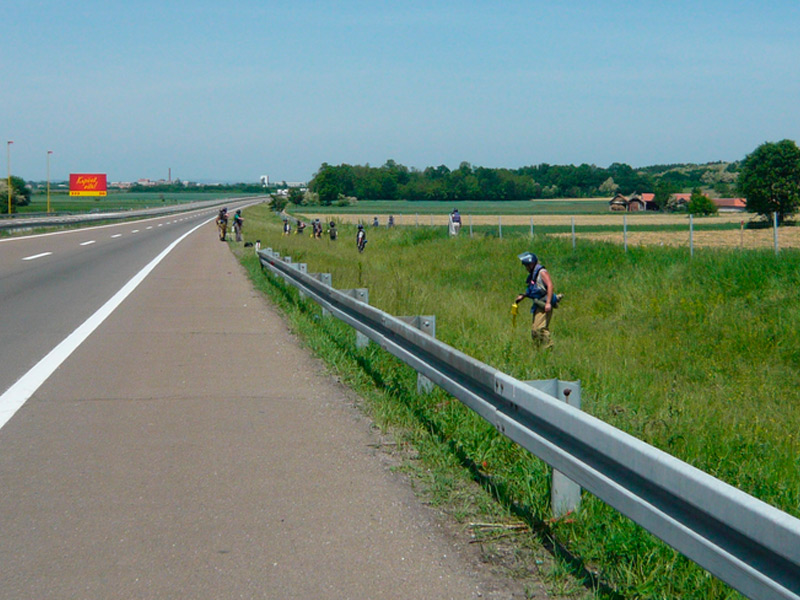
Technical reconnaissance is a set of measures carried out using technical means to collect and analyze information regarding the fact of the presence of CWM, determine their type, location, nature and condition, and the level of contamination of the area (object) in order to make decisions based on the obtained results and evidence regarding the release of land, reduction of boundaries of the area to be cleared, or the need for subsequent work to clear the area of CWM (demining).
When performing works for the search and survey of the area for the presence of CWM, as well as cultural heritage sites and archaeological research, we use modern magnetometry technologies that allow for rapid collection, analysis, processing, and transmission of data.
The three-channel magnetometric system Magnex 120 LW we use is a modern, highly effective method for surveying an area for the presence of CWM in various environments at depths of up to 6 meters, and with additional available cables, at depths of up to 100 meters, with the capability for magnetic cartography and satellite positioning using a hardware-software complex for uploading and processing the obtained data into a geographic information computer system.
A ground-penetrating radar (GPR) is a modern professional instrument for geophysical exploration (georadar) of soil and aquatic environments, engineering structures, and building constructions. GPR scanning solves a wide range of archaeological, technical, and engineering tasks. The GPR's probing depth reaches 20 meters, and the scanning result – a radiogram – clearly shows the picture of the subsurface environment and the depth of inhomogeneities. Unlike inductive CWM detection devices, the GPR is of particular interest because it can "see" various metallic and non-metallic objects, as well as voids beneath the soil layer, in the masonry of building walls, and in foundations.
Advantages of using GPR: